CaliClaw Defense
Take On Any California Franchise Tax Board Collections Case, From a Bank Levy to a Wage Garnishment to a Balance They Invented
A three-week live intensive where California tax pros build the only working system for the full range of FTB collections. Bank levies, wage garnishments, bank and income intercepts, liens, and the inflated balances that show up when returns go unfiled. Release it, reduce it, or knock it down — and stop turning these cases away.
"He handled my state tax issue in less than 24 hours. The state had levied my account and he got back all my money no problem. The guy is the real deal." — Yelp client
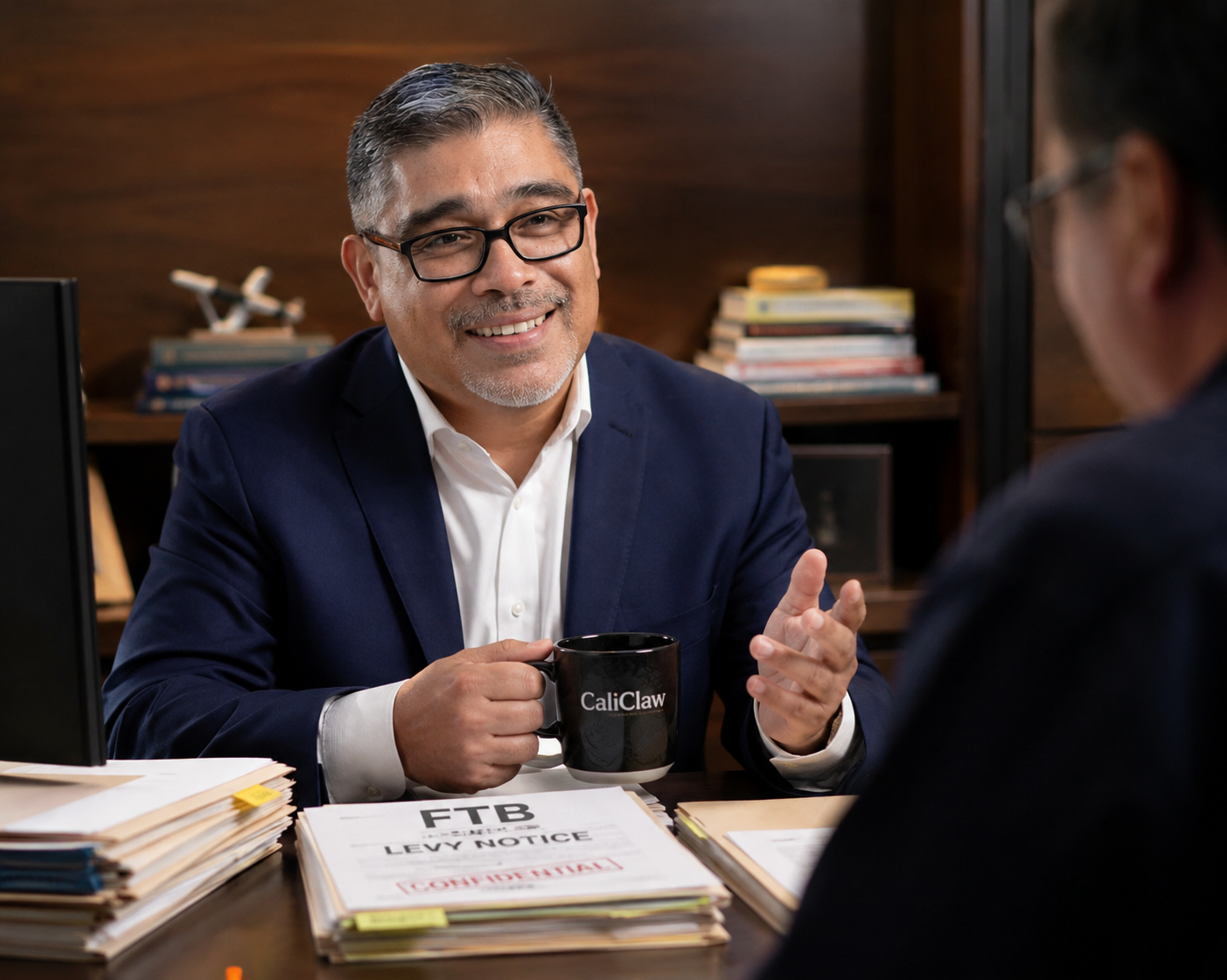
Carlos Samaniego, EA · NTPI Fellow · Instructor
There is no other training for this
Not a seminar. Not a course. Not a book on a shelf.
Until now, when the FTB came collecting, you Googled procedures and pieced it together on the clock.
This is the first and only place a California practitioner can build a real FTB collections defense system, live, from real cases.
You are looking at the only one.
One Case, Start to Finish
The FTB Took $15,000 From a Woman on Social Security. He Got Almost All of It Back.
Michelle lived on Social Security while fighting serious health problems. The FTB seized $15,000 from her bank account with no warning. Her entire life savings. Rent money, food money, money to get to medical treatment. She tried to reach the FTB herself and got nowhere. She found Carlos through his YouTube channel and reached out in desperation. He went to work that day. The FTB pushed back and called the funds overdue taxes. Through persistent negotiation he recovered 98 to 99 percent of her money, roughly $15,000 minus a small good-faith payment.
This is the exact play you will build in three weeks.
Every Way the FTB Comes After Your Client
Michelle's case was a bank levy. The levy is the most urgent FTB emergency, so it leads. But this is not a bank levy class. It is the full range of California Franchise Tax Board collections.
- 01Bank levies and Orders to Withhold
- 02Wage garnishments
- 03Bank and income intercepts, including grabbed refunds
- 04Liens
- 05The inflated balances that hit when returns go unfiled — and how filing the real returns knocks them down
- 06Hardship status, installment agreements, Offer in Compromise, and the Taxpayer Advocate
If the FTB is collecting, this covers it.
You Are Good at This. Until Sacramento Calls.
You handle IRS cases. You have taken a file through a Revenue Officer standoff and come out the other side. You know how to triage. You know how to stabilize.
Then a client calls. A bank levy from Sacramento. A wage garnishment that already hit. An intercept that grabbed their refund. A balance the FTB invented because the returns were never filed. And the ground moves. The FTB runs on a faster clock than the IRS. The notice window is shorter. The wage order hits before you have pulled the POA.
You are not a beginner. You are a sharp practitioner with one blind spot. Patch it, and you become the person every other pro in your area sends their California cases to. The one they call when the state shows up.
The Real Problem
The FTB Is Not the IRS With a State Seal
The IRS has procedures. Timelines, rights, Collection Due Process hearings, and enough friction that a skilled EA can find room to work.
The FTB does not work that way.
It can levy a bank account on a notice window most clients miss. It can have an employer withholding wages before your client even tells you. It can grab a refund through an intercept with no warning. When returns go unfiled it invents a balance and starts collecting on a number it made up. The Taxpayer Advocate is real, but most practitioners do not know when or how to use it. The Offer in Compromise rules are different enough from federal that assuming parity costs people money.
Here is what the gap actually costs you. Every California case you turn away is a full collections engagement walking out your door, and the client who needed you most ends up with someone worse. Every California case you take without a system, you work for free on nights and weekends figuring out what you should already know. Both bleed you.
One average FTB engagement is worth more than this entire intensive.
You Can Google It. You Still Won't Have a System.
You can read the statutes. You can sit through a half-day seminar that covers state collections in a slide deck. None of it hands you something you can run when the phone rings.
What you need is not more information. It is a process built from real California cases. Triage steps in the right order. Response timelines mapped to the actual FTB notice sequence. A decision framework for when hardship is the angle, when an installment agreement is the play, when filing the real returns kills an invented balance, and when you pick up the phone to the Taxpayer Advocate.
That system has not existed anywhere you could buy it. You are about to build it.
The Method
Map. Triage. Resolve. The CaliClaw Defense Method.
Every case you run in this intensive moves through the same three moves — the system Carlos built over a decade of real FTB collections files.
Map.
Know exactly where you are the moment the client calls, across any collection action — levy, garnishment, intercept, lien, or invented balance — from first notice to enforcement, so you stop reacting blind.
Triage.
Run the first 24 hours on a fixed protocol. Notices, balances, bank status, wage status, filing status, POA reality when there is no time. Stop the bleeding before it spreads.
Resolve.
Get the levy or garnishment released or reduced, the intercept addressed, the invented balance corrected by filing the real returns, and the right long-term lane set — hardship, installment, OIC, or advocate — in the right order.
By the end you do not have notes on a method. You have the method, in your hands, ready for the next case.
For
This is for you if
You are an EA or CPA practicing in or serving California who already handles collections work, and FTB cases make you hesitate.
You know IRS collections. You just do not have a process for the state. This intensive gives you one.
"When clients come to me with IRS levies, wage garnishments, unfiled returns, or California FTB problems, I refer them to the best: Carlos and Elizabeth Samaniego of Tax Debt Consultants. Together, they've helped hundreds of families resolve tax debt and rebuild their financial lives." — Millie, MVP Financial Services
Not For
Who it's not for
- Practitioners who have never handled a collections case of any kind. Start with IRS fundamentals first.
- Anyone looking for a general survey of FTB, or for audit and exam defense. This is collections defense only.
- Practitioners with no California exposure. If none of your clients touch the FTB, this is not for you. Out-of-state pros with California clients are welcome.
Curriculum · 6 Sessions
What You'll Build in Three Weeks
Six live sessions over three weeks. You build the system one move at a time.
The CaliClaw Map
You stop reacting blind. The mental model for how FTB collections move across every action — levy, garnishment, intercept, lien, and the invented balance from unfiled returns — the deadlines that matter, and where any file sits on the timeline. You leave knowing exactly where you are in any FTB case.
First 24-Hour Triage
The "I don't have a playbook for this" feeling dies here. You build your own intake script and triage checklist live: notices, balances, bank status, wage status, filing status, other agency exposure, POA reality when time is short. You leave with a first-call process you can run on any new FTB case.
Levies, Garnishments, and Intercepts
The scariest territory in FTB collections. How bank levies, Orders to Withhold, wage garnishments, and intercepts actually work, how much they take and for how long, and the step-by-step play to get them released or reduced. You draft a one-page response sheet you will use on every case.
Invented Balances, Hardship, and the Right Lane
How to kill an inflated balance by filing the real returns, create breathing room fast, and pick the right long-term lane. Hardship arguments, installment agreements, when Offer in Compromise is real versus a stall, and how to use the Taxpayer Advocate. You leave with a decision tree you can run against any open case.
Live Case Lab
No hypotheticals. Real anonymized files, run live through the new system. Triage, timelines, recommended moves, and how to scope and price the case. This session turns the system into reps.
Build Your FTB Lead Machine
The capstone, and the part most training never touches. You do not just learn where FTB collections clients come from, you build the thing that brings them in. You build a live FTB landing page that captures collections leads, starting from a proven template you customize to your practice, and you leave with the simple marketing system to drive traffic to it. Every participant walks out with a working lead page and a plan to fill it.
What you walk out with
- 01FTB collections triage checklist and first-call intake script
- 02Levy, garnishment, and intercept response sheet
- 03Hardship vs. installment agreement vs. OIC decision tree, plus the invented-balance playbook
- 04One concrete FTB client acquisition plan
- 05Six sessions of real case walk-throughs with full annotations
- 06A live FTB lead page and a simple system to fill it (bonus)
This is your working system. Tools you build during the intensive and run the next Monday.
Bonus
The FTB Lead Machine, Included
Winning FTB cases is half of it. Getting them is the other half, and it is the half most practitioners never solve. So the final session is a build. You leave with a live FTB landing page that captures collections leads, customized to your practice, plus the simple marketing system to drive traffic to it. The same way Carlos brings FTB cases through the door. You will be able to handle the cases and get them. That is the whole point.
Instructor
About Carlos Samaniego
Carlos Samaniego is an Enrolled Agent and NTPI Fellow, founder of Tax Debt Consultants LLC, operating nationally as The Tax Debt Detective. Two decades working California financial problems. Over a decade specifically on IRS and California FTB collections.
He is the bestselling author of How to Make the IRS an Offer They Can't Refuse and the author of Shut Down CaliClaw, the consumer guide to beating the California Franchise Tax Board. Between the two books, he has put the entire collections playbook — federal and state — into print.
Carlos is not an academic. Every session comes from real cases, real clients, and the real decisions made under pressure.

From the Author
He Wrote the Book on CaliClaw
Shut Down CaliClaw is the consumer guide Carlos wrote so California taxpayers would stop getting steamrolled by the Franchise Tax Board. The brutally honest field manual to bank levies, wage garnishments, intercepts, liens, and the balances the state invents when returns go unfiled.
The intensive is the practitioner version of that book. The same system Carlos uses on live cases, taught directly to the ten tax pros in the room. You are not learning theory. You are learning the playbook the author runs.
Federal collections. State collections. Both books. One instructor.
From the Field
From the field
""We found Carlos online when the FTB was trying to charge my family member over $40,000 of taxes for some old years and they just made up the numbers. Carlos was able to get the tax returns filed, and eliminated the $40,000 balance."
""Mr. Samaniego truly is the Godfather of Tax Resolution. I couldn't sleep, and was stressed, and he eased my concerns. He communicated with the FTB on my behalf and after a few calls, my problem was resolved. I highly recommend him."
""If you are having tax problems that feel insurmountable, call Carlos for a free consultation. He is both knowledgeable and aggressive when settling your tax debt in the most effective manner possible. If you have problems with the IRS and/or the Franchise Tax Board, call Carlos. You won't regret it."
""Carlos and his team treat you with respect, listen, and quickly help you identify a path forward, one that you can absorb. I felt a real integrity combined with a genuine desire to help. Can't thank him enough, or recommend him more highly."
""Carlos was available and walked me through step by step the process, what my rights were, and how to communicate properly with the FTB to get my funds released. It was just as he shared and expected. I am so grateful for his knowledge, his expertise, his care and concern for the people. Thank you Carlos and office!!"
Results vary. No outcome is guaranteed.
One Case Pays for the Whole Thing
This is the simplest math in your practice. One average FTB collections engagement is worth more than this entire intensive.
Take a single California case you would have turned away, or rescue one client whose account just got cleaned out, and the intensive has paid for itself the first week you use it.
Everything after that is profit on a skill you keep for the rest of your career.
Pricing
Ten Seats. No Exceptions.
Pricing is announced to the waitlist first.
Join below to get the number, and the enrollment window, before anyone else.
The ten-seat cap is real. Session 5 is a live case lab, and it only works if the group stays small enough for every person to get time on the hot seat.
The Guarantee
Attend the first two sessions. If you decide this is not right for your practice, contact me before Session 3 and I will refund your enrollment or apply it to a future intensive.
What I will not refund: not showing up, not doing the work, then asking for your money back at the end. You are a professional. Treat this like a professional commitment.
Frequently Asked Questions
No. The intensive assumes you already know collections work. It is built for the gap between handling IRS cases confidently and having a working FTB process. If you are turning away California cases or taking them without a real system, this is the right level.
One last thing
The Next Time a Client Calls You From a Parking Lot, You Will Know Exactly What to Do.
You will know the timeline. You will know who to call. You will know whether hardship is the angle or whether an installment agreement buys more time. You will run the triage checklist you built in Session 2 and pull the decision tree from Session 4, and you will move.
That is what this intensive produces. Not information. A system. Yours.
"He handled my state tax issue in less than 24 hours. The state had levied my account and he got back all my money no problem. The guy is the real deal." — Yelp client
Enrollment opens soon. Join the waitlist to be notified first.